Data-driven fleet management: how to reduce costs and increase operational efficiency
Understand how using data in fleet management helps reduce costs, increase operational efficiency and make more strategic decisions.

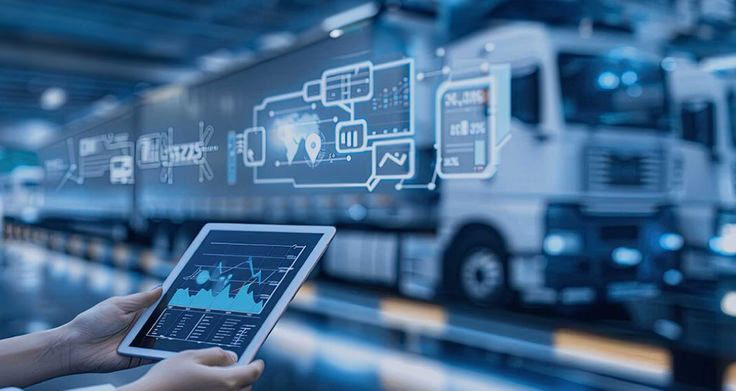
Fleet management has evolved significantly in recent years. In a scenario where operational costs, efficiency and control are priorities, making data-based decisions is no longer a differentiator and has become a necessity.
Companies and public agencies that still operate with manual controls or decentralized information struggle to identify waste, anticipate problems and optimize their resources. Data-driven management, on the other hand, enables a clear view of the operation and greater predictability in results.
The role of data in fleet management
Data is the foundation for more efficient management. Information about fueling, maintenance, mileage and vehicle use helps to understand fleet behavior and identify improvement opportunities.
When well structured, this data makes it possible to:
- Reduce fuel waste
- Plan maintenance more efficiently
- Identify vehicles with high operational cost
- Improve control and transparency
- Make faster, more assertive decisions
How to apply it in practice
To use data strategically in fleet management, it is essential to structure a few points:
Centralizing information
Gathering all data in a single system avoids inconsistencies and makes analysis easier.
Use of integrated technology
Solutions that connect fueling, maintenance, telemetry and tracking make management more complete and efficient.
Continuous monitoring
Analysis must be constant, allowing quick adjustments and continuous improvement of the operation.
Clear indicators
Defining metrics and tracking results is essential for performance-driven management.
Operational efficiency in practice
By adopting data-based management, the operation becomes more predictable and controlled. Problems are no longer handled only after they happen and start to be identified in advance.
This directly impacts:
- The reduction of operational costs
- The improvement in vehicle usage
- The increase in asset lifespan
- The efficiency in resource use
Integration with the employee experience
The evolution of management also involves integration with the end user. Solutions like CusCuz Benefícios broaden this view by bringing more convenience and control to employees' daily routines.
This integration contributes to a more efficient operation, connecting management and experience in a single ecosystem.
Conclusion
Data-driven fleet management represents an important step forward for companies seeking more control, efficiency and competitiveness.
More than tracking indicators, it is about turning information into strategy. Organizations that adopt this model manage to reduce costs, optimize processes and make decisions with more confidence.
In today's scenario, managing a fleet efficiently is, above all, managing based on data.
Simplify your fleet management with Bamex
Fueling, maintenance, tolls, tracking and benefits on a single platform. Talk to us and find out how.